
Communities in Kiryandongo and Adjumani are turning conversation into a call for action on child marriage, teenage pregnancy and girls’ education.
Every girl has a dream.
For some, that dream is to become a teacher, nurse, journalist, entrepreneur or community leader. For others, it is simply the opportunity to complete school, develop their potential and build a better future. Yet for many girls, these aspirations are interrupted by early and forced marriage, teenage pregnancy, and limited access to accurate sexual and reproductive health and rights (SRHR) information and services.
When a girl’s education is interrupted, the consequences can extend far beyond the classroom. Her health, choices, economic opportunities, confidence and ability to shape her own future may all be affected.
The scale of the challenge is significant. Uganda’s 2022 Demographic and Health Survey found that 34 percent of women aged 20–24 were married or in union before the age of 18, while 24 percent of girls aged 15–19 had already begun childbearing. Behind these statistics are real girls whose education, health, choices and opportunities can be profoundly affected.
Beyond “Stay in School”
The challenges facing girls cannot simply be reduced to individual choices or a failure to “stay in school.” Poverty, social expectations, unequal power relations, limited access to accurate information and services, and gaps in protection and support all shape the realities that girls experience.
This is why telling girls to “stay in school” is not enough.
Families, schools, communities, health workers, leaders, government institutions and development partners all have a role to play in creating an environment in which girls can remain in school, access the information and services they need, and pursue their aspirations safely and with dignity.
Using Film to Start Difficult Conversations
Through the Media for Social Change Programme, the Refugee Law Project (RLP) has been using community storytelling and facilitated film screenings to create safe spaces where difficult issues can be discussed openly.
With support from the Embassy of the Kingdom of the Netherlands in Uganda, the programme is bringing communities together to use film and dialogue as tools for awareness, reflection and collective action.
The short film Silent Victims has provided a powerful starting point for communities to reflect on the experiences of girls and examine what families, communities and institutions can do differently.
Kiryandongo: A Community Conversation
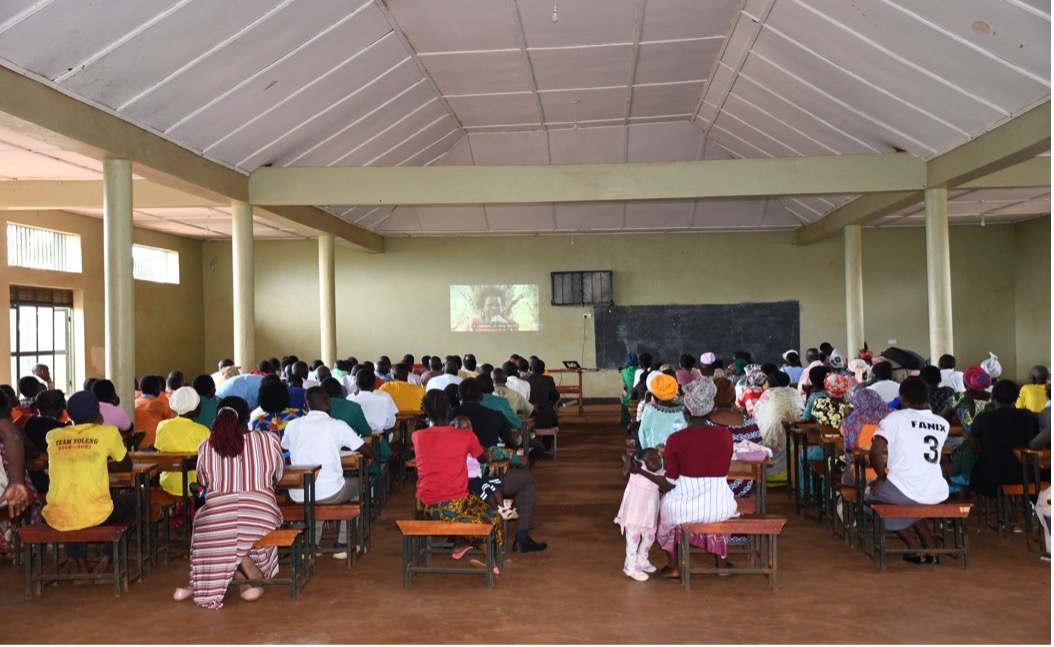
In Kiryandongo District, a community film screening at Charlene Secondary School in Kirwala Village, Kyankende Sub-county, brought together 151 participants, including parents from Kirwala Primary School, Bunyama Primary School and Charlene Secondary School.
Local leaders, teachers, health workers and the District Probation Officer also participated in the engagement.
Following the screening of Silent Victims, participants discussed how early marriage and teenage pregnancy affect girls’ enrolment, retention and completion of education. The conversation highlighted that protecting girls cannot be left to girls alone. Families and communities must also take responsibility for creating an environment where girls are protected, supported and encouraged to remain in school.
The discussion demonstrated the value of creating spaces where different actors can come together, listen to one another and collectively examine the challenges affecting girls.
Adjumani: Giving Adolescents a Voice
The conversation continued in Adjumani District, where RLP held a community-facilitated film screening at Aliwala Primary School in Itirikwa Sub-county.
Adolescents, parents, teachers, caretakers and other stakeholders watched Silent Victims and openly discussed issues including forced marriage, teenage pregnancy, and limited access to accurate SRHR information and services.
Participants shared experiences, asked questions and explored possible solutions. Importantly, adolescents were given space to speak about issues that directly affect their lives.
Creating such spaces is essential. Young people are not simply recipients of information or beneficiaries of programmes; they have experiences, perspectives and ideas that should inform the conversations and decisions affecting their lives.
The Gendered Cost of Interrupted Education
From a gender perspective, the consequences are particularly serious for girls.
When a teenage girl becomes pregnant, she is often the one expected to leave school. When a girl is forced into marriage, her education and future economic opportunities may be severely constrained. When she seeks information about her reproductive health, she may encounter stigma instead of support.
These realities reinforce the importance of addressing the social and structural factors that place girls at greater risk.
The responsibility for preventing these outcomes must therefore be shared. Families have a role in supporting girls and maintaining open communication. Schools have a responsibility to create safe and inclusive learning environments. Health workers must provide accurate, accessible and appropriate SRHR information and services. Community and political leaders must respond to child protection concerns, while government and development partners must strengthen systems that protect and empower girls.
The Real Test Begins After the Film Ends
A film screening is not the end of the intervention.
The real test begins after the film ends.
Will parents have more open and honest conversations with their children?
Will teachers identify and support girls who are at risk of dropping out?
Will adolescents be able to access accurate SRHR information and appropriate services?
Will community leaders take action when child marriage is identified?
Will girls who become pregnant receive the support they need to continue or return to education?
These are the questions that turn awareness into accountability.
Film can open the door to conversation, but meaningful change requires action beyond the screening. It requires communities and institutions to follow through on the commitments that emerge from those conversations.
From Conversation to Collective Action
Uganda already has a National Strategy to End Child Marriage and Teenage Pregnancy, recognising the need for coordinated action across sectors. The challenge is to translate these commitments into meaningful action at the community level, where girls live, learn and make decisions about their futures.
The experiences from Kiryandongo and Adjumani demonstrate that communities are willing to engage with these difficult issues.
The 151 participants in Kiryandongo and 244 adolescents and families in Adjumani, alongside teachers, health workers, leaders and child protection actors, demonstrate a willingness to listen, discuss and explore solutions.
The challenge now is to turn that willingness into sustained action.
Girls’ Voices Must Be Heard
The film may be called Silent Victims, but the girls affected by child marriage, teenage pregnancy and interrupted education should never remain silent.
Their voices matter. Their education matters. Their choices matter. Their future matters.
Every girl deserves the opportunity to complete her education, access accurate information and services, make informed decisions about her life, and pursue her aspirations without being constrained by circumstances beyond her control.
The journey must therefore move from screening to dialogue, from dialogue to commitment, and from commitment to measurable action.
Protecting the girl child is not the responsibility of one organisation or one community. It is a collective responsibility.
The time to act is now.
Blog by Ajok Diana